
The short answer
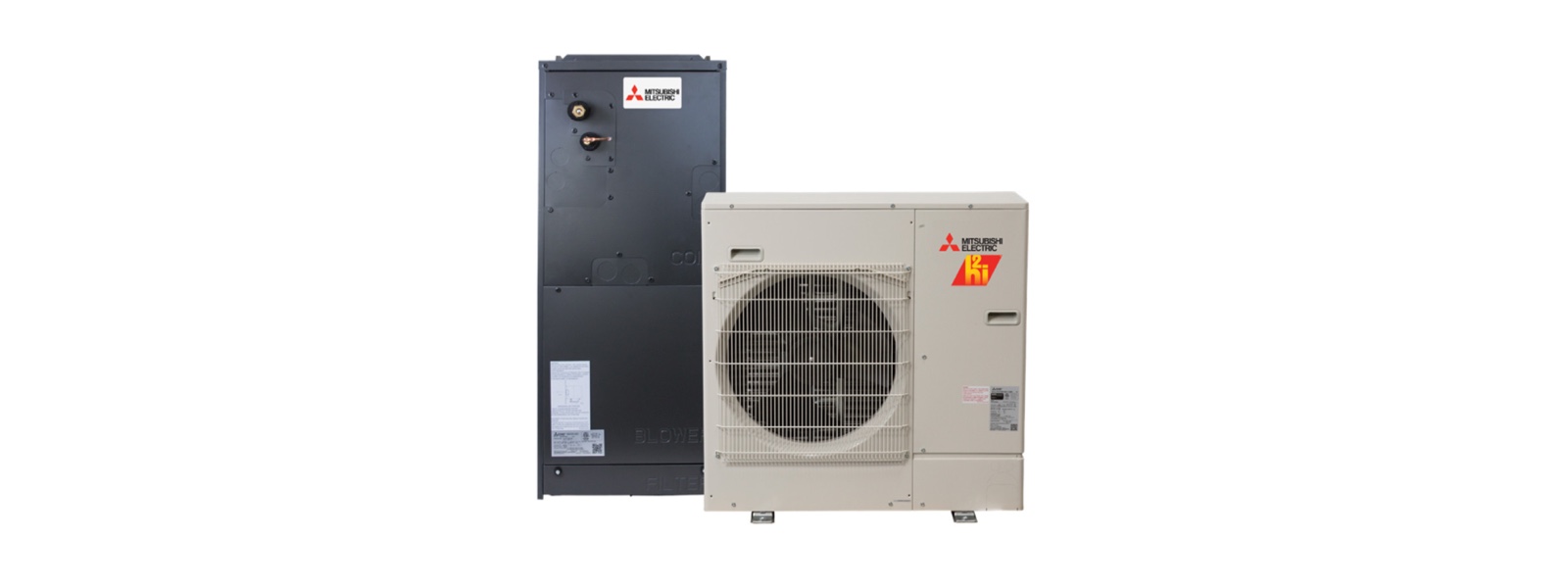
A Mitsubishi SVZ ducted air handler and heat pump replace a traditional furnace and coil on your existing ducts with an all-electric system: 36–45 dB(A) indoors and no combustion. The SVZ-AP24NL is not a low-static unit; its 0.30, 0.50 and 0.80 in.WG settings are about what a furnace blower is built for, so the ducts must measure within that range.
In this guide
Many Vancouver homes we walk into have the same setup in the garage or utility closet: a tall gas furnace with an evaporator coil sitting on top of it. When the homeowner wants to go all-electric, needs the space back, or is tired of a loud blower, the conversation usually turns to a ducted heat pump paired with a ducted air handler.
A ducted air handler like Mitsubishi's SVZ is not a mini-split: it uses your existing ductwork, with no wall cassette in the living room, so from inside the house it looks and behaves like a normal central system.
What "low static" actually means.
A "low-static" air handler is built for very little duct resistance: Mitsubishi's low-static ducted unit is the SEZ, rated for 0.02 to 0.20 in.WG and built for short duct runs. Static pressure is the resistance your ductwork pushes back with when the blower moves air through it, measured in inches of water gauge (in.WG).
A traditional furnace blower has to push air through the heat exchanger, a coil, a filter, and a full duct run. Most residential furnaces and air handlers are rated for 0.5 in.WG of total external static pressure, and National Comfort Institute reports that systems rated for 0.5 average about 0.82 in.WG in the field.
The SVZ is a different machine: the SVZ-AP24NL lets the installer select 0.30, 0.50 or 0.80 in.WG of external static pressure, with three fan speeds at each setting, so it can run a full house duct system the way a furnace blower does. The blower is an ECM (electronically commutated motor) that ramps smoothly instead of slamming on and off.
The two blowers, side by side.
The Mitsubishi SVZ-AP24NL blower is an inverter-driven ECM with selectable static settings and three airflow speeds at each, while many older furnaces use a single-speed PSC blower. Specs below are from Mitsubishi's 2025 submittal for the SVZ-AP24NL with the SUZ-AK24NLHZ hyper-heating outdoor unit.
| Mitsubishi SVZ-AP24NL | Conventional furnace + coil | |
|---|---|---|
| Blower motor | Inverter-driven ECM | PSC on many older furnaces; newer ones meet a 2019 federal fan-efficiency standard |
| External static rating | 0.30 / 0.5 / 0.8 in.WG, selectable | Most rated for 0.5 in.WG; field average about 0.82 in.WG |
| Airflow | 471 / 573 / 700 CFM, 3 speeds at each setting | Single-speed blowers: full blast or off |
| Fan motor output | 121 W | Varies by furnace and blower setting |
| Indoor sound | 36–45 dB(A) | Varies by furnace; a single-speed blower has no low setting |
| Capacity turndown | 12,300–25,000 BTU/h cooling | Single-stage furnaces: 100% or 0% |
| Cabinet | 17″ W × 21⅝″ D × 39-13/16″ H | Furnace + coil + plenum transition stack |
| Mounting | Multi-position: vertical up/down, horizontal left/right | Per model, less flexible |
| Combustion | None (all-electric) | Gas line, flue, combustion air, CO risk |
Why fighting static pressure is expensive.
Fighting static pressure is expensive because of the fan laws: airflow rises in direct proportion to fan speed, static pressure rises with the square of fan speed, and the power the motor consumes rises with the cube of it. Spin a blower 25% faster to overcome restrictive ductwork and you're drawing roughly double the power to do it.
Pushing harder against bad ducts is the most expensive answer available, and the energy that doesn't become airflow becomes heat and noise. The roar from the vents in a high-static system is turbulence, wasted power made audible.
Motor type compounds the cost. Many older furnace blowers use a PSC (permanent split capacitor) motor, which runs at essentially one speed and loses efficiency as static pressure climbs against it; furnace fans built since July 3, 2019 have to meet a federal fan-efficiency standard. An ECM (the electronically commutated motor in the Mitsubishi unit) is a brushless DC motor with onboard electronics that adjusts to hold its target airflow. The SVZ-AP24NL's fan motor output is rated at 121 watts, and the U.S. Department of Energy found that ECM-type furnace fan motors run more efficiently than PSC motors and hold that efficiency across their operating range.
Over the hundreds of hours a blower runs each season, that difference shows up on the power bill, whether the system is heating, cooling or just circulating.
Head to head.
Against a traditional furnace and coil, a Mitsubishi ducted air handler comes out ahead on comfort, noise and footprint and burns no gas; which one costs less to heat with depends on local gas and electric rates.
Airflow and comfort
A traditional single-stage furnace is basically on or off. It blasts 120°F+ air until the thermostat is satisfied, then shuts down, so the house swings between a hot blast and a slow drift down, and rooms far from the furnace never quite keep up.
The Mitsubishi air handler pairs with an inverter-driven outdoor unit and modulates. The SVZ-AP24NL runs airflow at roughly 471 / 573 / 700 CFM depending on speed, and the system throttles capacity to match the actual load. Paired with the SUZ-AK24NLHZ, the 2-ton system can dial down to about 12,300 BTU/h in cooling and 10,700 BTU/h in heating. The system runs long, gentle cycles at low output instead of short violent ones, and those even temperatures are the single biggest comfort difference.
Noise
Mitsubishi rates the SVZ-AP24NL indoor unit at 36–45 dB(A) depending on fan speed: the low setting sits near a quiet bedroom at night (35–40 dB) and high is about a running refrigerator (45 dB). A single-speed furnace blower has one speed, full, so it never runs at those quieter low settings.
Footprint
A furnace-plus-coil stack is a tall assembly plus the plenum transition above it. The SVZ air handler cabinet is about 17″ wide × 21⅝″ deep × 39-13/16″ tall and mounts multi-position: vertical up or down, or horizontal left or right. That means a closet, an attic, a crawlspace, or a tight mechanical room all become viable. On remodels and older homes that lost mechanical space to an addition, that flexibility is often the deciding factor.
No combustion
A gas furnace needs a gas line, a flue, combustion air and periodic heat-exchanger inspection, and it carries a small but real carbon monoxide risk. The Mitsubishi air handler is all-electric, which is the whole point for anyone electrifying or for a house with no gas service.
Cold-weather heating
Modern hyper-heating heat pumps keep heating in hard cold: Mitsubishi rates its Hyper-Heating (H2i) outdoor units for 100% heating capacity down to 5°F with guaranteed heating down to −13°F, colder than Portland's all-time record low of −3°F. Paired with the SVZ-AP24NL, the SUZ-AK24NLHZ still delivers up to 17,200 BTU/h at −13°F. More in our guide to heat pump cold-weather performance.
Efficiency and operating cost
A furnace's efficiency is AFUE, how much of the gas becomes heat, capped at 100% by physics (95–97% on a good modern unit). A heat pump moves heat instead of making it, so it delivers more energy than it consumes: the SVZ-AP24NL and SUZ-AK24NLHZ pairing is rated at a COP of 3.3 at 47°F, about three units of heat per unit of electricity. Which is cheaper to run comes down to your local gas-versus-electric rates, but on the cooling side there's no argument. This pairing is rated 18.6 SEER2, against 14.3 SEER2 for the single-stage Silver air conditioner in our entry AC-and-furnace package.
Where the traditional system still wins.
A traditional furnace-and-coil system is still the better call in two cases:
- Gas is cheap and the house is already piped for it. If you have gas service, a working flue, and low rates, the payback math on switching can be long.
- You need very high capacity on a tight budget. Furnaces scale up inexpensively.
How we decide on-site.
We decide on-site with a manometer: one probe in the supply plenum, one in the return, added together for total external static pressure. That single reading tells us what the ductwork is really doing.
The static pressure reading decides the recommendation. If the ducts read within the SVZ's 0.80 in.WG top setting, the air handler is an excellent fit. If they read high, we find out why: undersized returns, a crushed trunk line in the crawlspace, a filter rack choking the intake, closed dampers. Then we tell you what it takes to fix it. Sometimes the ductwork gets corrected and the air handler goes in. Sometimes the honest call is a different system.
We also run a Manual J load calculation so the equipment matches the house instead of the old nameplate, and check where the equipment has to live and what electrical service you have.
When the ductwork is beyond saving or doesn't exist, the answer can be a ductless mini-split instead; see our comparison of ductless versus ducted.
If you're weighing a changeout, request a quote and we'll measure your static pressure, run the load, and tell you straight which system your house should get. As a Mitsubishi Diamond Contractor, we install Mitsubishi's SVZ ducted air handler with up to a 12-year factory warranty.
Questions homeowners ask.
What does "low static" mean for a Mitsubishi air handler?
Static pressure is the resistance ductwork pushes back with when a blower moves air through it, measured in inches of water gauge. Mitsubishi's low-static ducted unit is the SEZ, rated for 0.02 to 0.20 in.WG and meant for short duct runs. The SVZ air handler is not a low-static unit: the SVZ-AP24NL offers selectable 0.30, 0.50 and 0.80 in.WG settings, so it can run a full house duct system, and the ducts still have to measure within that range.
How does a Mitsubishi ducted air handler compare to a furnace blower on noise?
Mitsubishi rates the SVZ-AP24NL indoor unit at 36–45 dB(A) depending on fan speed. That runs from about a quiet bedroom at night (35–40 dB) on its low setting to about a running refrigerator (45 dB) on high. A single-speed furnace blower has one speed, full, so it never runs at those quieter low settings.
Why does fighting duct static pressure cost so much more energy?
Airflow rises in direct proportion to fan speed and static pressure rises with the square of fan speed, but the power a motor consumes rises with the cube of it: spin a blower 25% faster to overcome restrictive ductwork and you're drawing roughly double the power. The energy that doesn't become airflow becomes heat and noise. The U.S. Department of Energy found that ECM-type furnace fan motors run more efficiently than older PSC motors and hold that efficiency across their operating range, and Mitsubishi rates the SVZ-AP24NL's ECM fan motor at 121 watts of output.
When does a traditional furnace-and-coil system still make more sense?
A furnace-and-coil system can be the better call when gas is cheap and the house is already piped for it with a working flue, since the payback on switching can be long. It also makes sense when very high heating capacity is needed on a tight budget, because furnace prices barely change with size.
How is the decision made between a Mitsubishi ducted air handler and a conventional system?
A manometer reads total external static pressure across the supply and return. Most residential furnaces and air handlers are rated for 0.5 in.WG, and National Comfort Institute reports that systems rated for 0.5 average about 0.82 in.WG in the field. The SVZ-AP24NL tops out at a 0.80 in.WG setting, so if the ducts read within its range it is a strong fit; if they read high, the ductwork issue gets diagnosed and fixed, or a different system gets recommended.
Sources and resources
Reviewed for accuracy by Sam Tsarenko, founder of Pacific Peak Mechanical. Equipment specifications cited are from Mitsubishi Electric Trane's 2025 SVZ-AP24NL & SUZ-AK24NLHZ submittal. This guide draws on the following primary sources:
- Mitsubishi Electric Trane: SVZ-AP24NL & SUZ-AK24NLHZ submittal and SEZ-AD12NL low static submittal, for static settings, airflow, sound, capacity and efficiency
- ENERGY STAR: Air-Source Heat Pumps, for heat pumps moving heat instead of making it from fuel
- HVAC Today: National Comfort Institute on rated vs. measured static pressure, for the 0.5 in.WG rating and 0.82 in.WG field average
- U.S. Department of Energy: Consumer Furnace Fans and the 2014 furnace fan final rule, for the July 3, 2019 standard and ECM vs. PSC efficiency
Related from Pacific Peak: Ductless mini-split installation · Heat pump installation · Cost estimator


